2D materials and condensed matter
Advancing quantum science through atomic-scale materials
The 2D materials and condensed matter theme at CQSE explores the extraordinary properties of materials just one or a few atoms thick. These materials, including graphene, hexagonal boron nitride, transition metal dichalcogenides, and van der Waals heterostructures, represent a quantum leap in materials science, exhibiting radically different properties from their bulk counterparts.
By combining quantum physics, materials engineering, nanofabrication, spectroscopy, and device science, our researchers investigate how atomic-scale materials can enable the next generation of quantum technologies.
The ability to engineer and probe matter at the atomic scale is redefining how we approach quantum science. Two-dimensional materials provide a versatile playground where quantum phenomena can be discovered, controlled, and translated into future technologies.
Radha Boya / Professor of Nanoscience and Royal Society University Research Fellow
Our research vision
Our vision is to understand, control, and harness quantum phenomena in low-dimensional materials and nanostructures. The theme brings together cutting-edge experimental and theoretical approaches to address fundamental questions in condensed matter physics while developing new platforms for quantum sensing, quantum information processing, and adaptive optoelectronics.
Our research spans diverse areas, including quantum sensing of confined liquids, topologically protected states, strongly coupled light–matter systems, and engineered quantum devices based on two-dimensional materials.
Key areas of research
Several research groups at The University of Manchester work across key areas of this theme, including:
-

2D material-based qubits
We explore the use of 2D materials as a platform for qubits, aiming to develop robust, scalable quantum computing architectures. Our research focuses on the manipulation and control of quantum states in 2D materials, such as bilayer graphene and transition metal dichalcogenides, and related heterostructures, we aim to develop scalable quantum architectures with long coherence times, tunable quantum states, and high operational fidelity.
Our work includes the manipulation of spin, valley, and excitonic degrees of freedom, as well as the design of electrically controllable quantum devices for future quantum computing applications.
-
Quantum sensing using 2D nanochannels
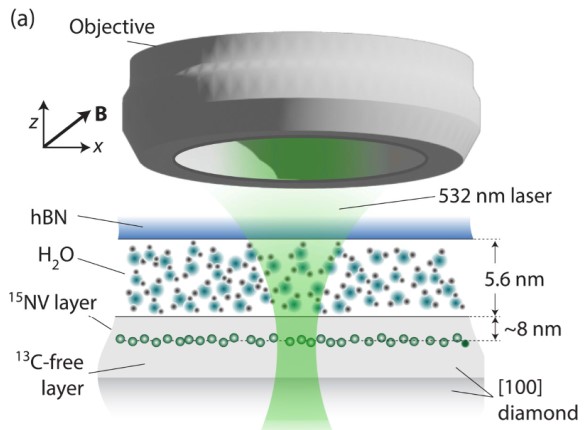
We explore nanochannels made from 2D materials as platforms for quantum sensing of liquids under extreme confinement. Colour centres, including native defects in hexagonal boron nitride and nitrogen-vacancy (NV) centres in diamond, act as atomic-scale probes capable of sensing local magnetic, chemical, and dynamical properties of confined water and molecular systems. By integrating quantum defects with nanofluidic architectures, we aim to enable nanoscale spectroscopy and imaging of interfacial phenomena with unprecedented spatial resolution.
-
Quantum polaritons in 2D heterostructures
We explore the intersection of light and matter in two-dimensional materials, focusing on hybrid light-matter quasiparticles in the mid-infrared spectrum. Through heterostructure engineering and nanoscale optical control, we investigate new regimes of strong light–matter coupling and collective quantum behaviour.
Our goal is to develop adaptive optoelectronic and photonic platforms for next-generation quantum communication, sensing, and information processing technologies.